



















The Ritual of Self-Love: How Embodiment Deepens Intimacy and Connection with Jessica Winterstern
In this intimate conversation, Jessica Winterstern invites us into the lived devotion behind her work, a journey shaped by sensitivity, profound grief, and a radical commitment to staying present within the body. What began as a search for understanding through psychology became a deeper descent into embodiment after the loss of her mother to early-onset Alzheimer’s. Through heartbreak, ritual, and nervous system healing, Jessica transformed self-love from a concept into a daily discipline – one that now anchors her teachings on feminine wellness, emotional resilience, and conscious partnership. Here, she shares how tending to the body, honoring grief, and slowing down can radically deepen intimacy, trust, and connection in modern relationships.
For those who may be new to your work, can you share a bit about your personal journey and what drew you into self-love, embodiment, and feminine wellness?
I have always been drawn to the depths of this being human. I came into this world highly sensitive, attuned to the unseen and unspoken threads in most rooms I entered. I could feel what others were carrying before they had language for it, sense the tension between people and recognize the unfelt pain behind someone’s tired eyes. At the time, this wasn’t harnessed or supported; rather, it was framed as fragility, as being too much, too porous.
Psychology became my way of understanding my sensitivity and learning to tend to the hurt in others. I studied it formally, earned degrees, and learned the theories and frameworks of the psyche. And yet, there was still a gap in my understanding. While I was able to grasp the architecture of the mind, I was not fully inhabiting my own body.
Everything changed when my mother was diagnosed with early onset Alzheimer’s. I was living in India at the time, trying to find God in yoga shalas and on the rocks of Hampi, when I received the call that reoriented my life. Watching my favorite person unravel before my eyes forced me into a descent I could not bypass.
There is nothing theoretical about your own mother looking at you and not knowing your name.
For years of her disease, I witnessed her die a thousand times before her final breath. Grief was no longer an emotion I studied, it became the atmosphere I breathed every day. I realized that if I didn’t learn how to stay in my own body during that time, I would disappear alongside her.
That was the turning point.
Self-love shifted from a mere concept into a discipline I returned to every morning and night. Embodiment felt less like spiritual language and became my survival as I learned how to stay with myself in the gravest devastation. Feminine wellness became my anchor, my devotion, as I relearned what it meant to be connected to my femininity and the thousand faces of the goddess. Learning how to remain present inside heartbreak became my daily ritual and I sought teachers and mentors across psychological, spiritual, somatic, and tantric lineages to support me through this descent.
Through losing my mother, I found myself.
Self-love is often talked about as the foundation of healthy relationships. How has developing your own self-care rituals influenced the way you relate to yourself and to partnership?
Self-love can feel amorphous in our modern culture, like this intangible buzzword we can’t quite grasp, but I see it as a daily reckoning, something we must return to again and again.
It isn’t always gentle. It isn’t just baths and candles, though I genuinely love those. It’s also sitting on the edge of the bed when I’m activated and asking myself what’s actually hurting instead of blaming my husband. It’s noticing when an old wound is speaking through me and choosing not to let it overtake the moment.
Self-love is staying.
Staying with shame instead of numbing it, staying with grief instead of hardening, staying with anger long enough to understand what boundary it’s attempting to protect.
My rituals slow me down enough to feel what I would otherwise override. They help me work with the trauma that lives in the body, not as a concept, but as sensation. A tightening in the chest. A bracing in the jaw, a collapse in the belly. When I tend to those places, I’m less likely to project them onto the person I love.
They also open me to pleasure, to aliveness, to eros, to desire. To the kind of intimacy that makes this life worthwhile.
In committing to stay at home within myself, both in shadow and in light, the ground beneath my partnership strengthens.
My husband and I are not “healed.” We are human. We are fallible. We trigger one another. We fumble. But we share a devotion to turning inward before we turn against each other, to laying down armor and staying with the tender heart.
Ritual keeps me in relationship with myself.
And when I am in relationship with myself, I can meet him with more openness, more tenderness, more aliveness and that’s where intimacy deepens.

Many women are navigating chronic stress and feeling disconnected from their bodies. What practices have helped you feel more grounded, present, and emotionally available in your relationships?
Somatic embodiment has been essential in navigating chronic stress and reconnecting to my body.
As women, we’ve been taught to abandon our bodies, to objectify them, numb them, disparage them and override them. But our bodies are temples of instinct and wisdom, of intuition and aliveness, awaiting our return to them.
Every day, I practice. I move what is stuck, what is unfelt, what is neglected. I dance. I shake. I moan. I quake. I undulate my spine, soften my belly, relax my jaw, cry my tears, snort with laughter. I breathe until sensation returns to the places that go numb when I dissociate or harden in the face of hardship. Sometimes it’s five minutes in the morning before work. Sometimes it’s sobbing on the kitchen floor with the intention of letting my heartbreak take up space as the coffee brews.
We must befriend not only the love and light in our lives, but also the density and darkness.
When emotions are allowed to be felt, they are less likely to calcify and turn to dis-ease and when stress is given space to move, it’s less likely to turn inward. These small, consistent practices can regulate our nervous systems and create internal spaciousness so that we are more available, emotionally, relationally, spiritually, and intimately.
From your experience, how does prioritizing feminine wellness and self-care shape communication, trust, and emotional safety with a partner?
Feminine wellness is about forming a relationship with the depths of the heart and learning the art of feeling our way through this one life.
I let my heart lead. I let my heart break. I let my heart bleed, and I trust its undeniable resiliency and infinite capacity. I believe the most dangerous thing we can do to stifle our wellness is harden.
So prioritizing feminine wellness looks like dancing with my grief before I weaponize it, it looks like singing my lament instead of projecting it, it looks like mothering the frightened parts within so they don’t unconsciously run my relationships.
When I tend to my nervous system, when I slow down and feel my breath, my communication becomes clearer and less reactive. And when I drop the thread of love and close my heart, which happens, I know how to return and repair from my center.
Emotional safety is not something I demand from my partner because it’s something I cultivate within myself first. From that grounded place, trust grows organically between us. We are both committed to this kind of devotion to love, and so safety is deeply felt. But it’s sourced from within.

HigherDOSE often speaks about wellness as a ritual rather than a task. What does a self-love ritual look like when it truly feels nourishing and sustainable, rather than overwhelming or performative?
The wellness industry has become noisy. It’s easy to feel inundated by the endless “tasks” of self-care — the supplements, the protocols, the routines — and there can be a performative quality that quietly undermines true nourishment.
Ritual is different.
Ritual slows a moment down enough to experience revelation in both the extraordinary and the mundane. It’s about being with oneself. Staying with oneself. Learning the language of your own nervous system so you can move through life more centered and open.
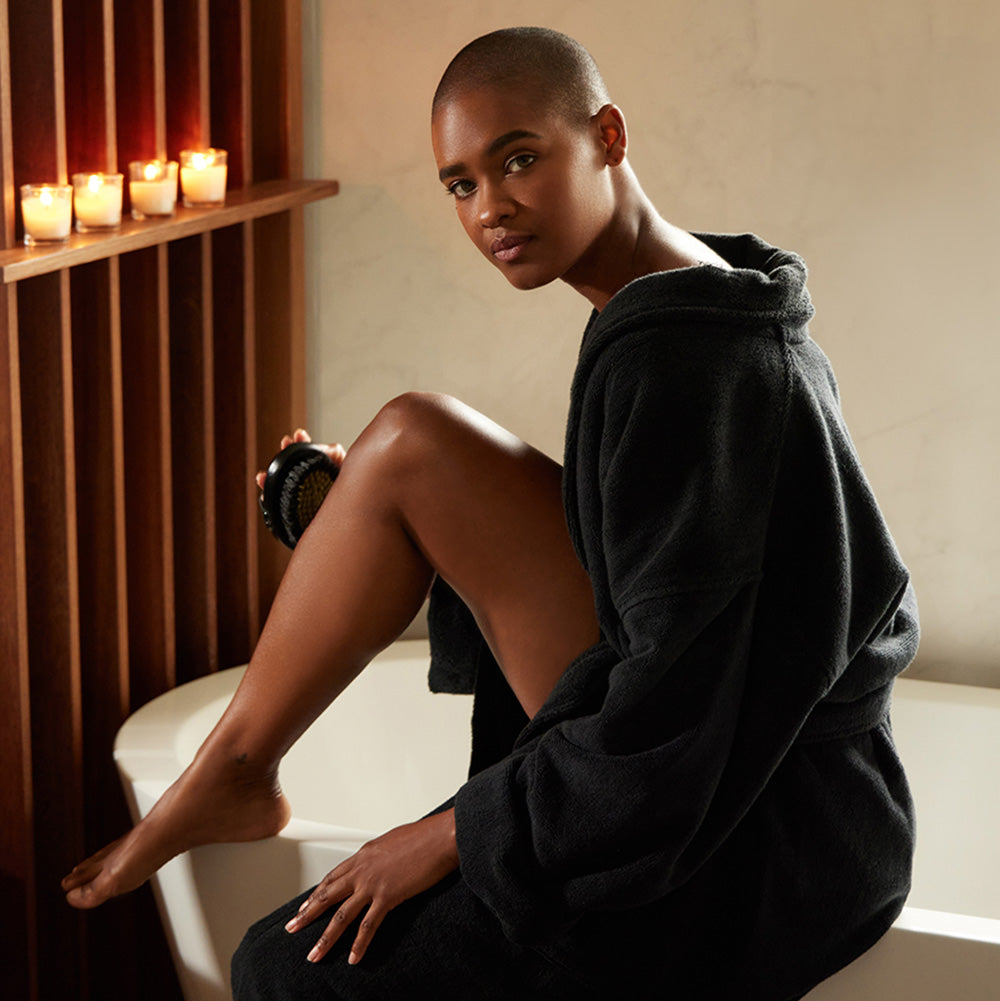
Sometimes it’s as simple as lighting candles in the morning and letting the light touch my skin, watching the amber glow move across the walls.
Sometimes it’s dancing while doing the dishes, letting my hips shift the atmosphere of the room while my husband devotionally witnesses me move through space, feeling his adoration land in my body and amplify my aliveness in real time.
Sometimes it’s my husband shaving my head after we lost everything in the fire, burying my long locks in the soil where our home once stood.
Sometimes it’s imagining my mother’s ghost sitting across from me, sharing my dreams and longings with her spirit while I cry without holding anything back.
And yes, I love red light therapy before bed. Infrared breaks between client sessions. Sitting on my PEMF mat in front of the fire, listening to binaural beats while studying archetypal psychology. I care deeply for this body and tend to it with intention.
But all of it must be in devotion to the moment.
If the heart isn’t moved, if aliveness isn’t felt, it isn’t ritual. It’s just another task.
Devoid of heart, wellness becomes performance. With heart, even the smallest act becomes a living ceremony between dirty laundry and back-to-back meetings.
Stress, burnout, and hormone shifts can quietly impact intimacy. How have you seen intentional self-care support both emotional resilience and deeper connection in romantic relationships?
We live in a world that honors productivity and doing far more than slowness and being. Learning to listen to the body is the first step in tending to it. Because we are conditioned to override stress, to keep going until we burn out, to dismiss hormonal shifts as inconveniences, we often miss the cues our bodies are sending.
As women rise in the world, many of us are leading more and feeling less, because who has the time to do it all? And yet, we desperately need a way forward that honors our bodies as temples and our hearts as wisdom holders.
We need simple practices that remind our nervous systems, I am here. I am safe. I am not going anywhere.
Intentional self-care allows me to bring all of myself into relationship, not just the polished, high-functioning parts, but the grief, the fatigue, the tenderness, the edge. It creates enough internal regulation that I’m not unconsciously asking my partner to stabilize what I haven’t tended within myself.
When we regulate our nervous systems and learn to listen inward without judgment or wrong-making, we become less reactive and more present. Emotional resilience isn’t about suppressing feelings, it’s about expanding our capacity to stay with them without collapsing or projecting them onto the person we love.
We will fumble. We will take our stress out on the people closest to us. That’s part of being human. But a steady commitment to practice, to self-care, to embodiment, to repair, widens our capacity over time. And as our capacity grows, so does the depth of intimacy we’re able to sustain.

For someone just beginning their self-love journey, what’s one simple practice or mindset shift you’d recommend starting with to create meaningful, lasting change?
Oh wow, there are so many practices I could suggest. But one of the most important places to begin is with a mindset shift: a willingness to honor yourself in your totality. And often, that begins by reconnecting with the younger you.
Find a private, quiet space and light a candle. Put on a song that brings you back to childhood, maybe a lullaby, maybe something that once made you feel safe or seen. Wrap your arms around your chest and begin to rock gently. Close your eyes and sway. Tend to yourself as if you are reuniting with that younger version of you.
When you’re ready, open your eyes and put pen to paper. Write her a love letter. Let her know you’re here now. That you’re not going anywhere. That she doesn’t have to navigate this world alone anymore.
It’s hard to live with an open heart when we haven’t established safety within. When the parts of us that feel scared or small are untended, they run the show in subtle ways. But when we make contact with the younger one in a tender, loving, mothering way, something begins to reorganize.
We stop abandoning ourselves in the small, daily moments. We begin to orient to life from self-connection instead of self-protection.
And perhaps the simplest practice I return to, again and again, is slowing down and asking: What would love do? How would love meet this very moment?
When love becomes the North Star, life recalibrates around that inquiry.
Photos by Emma Bilmes
Jessica Winterstern holds an MEd in Human Development and Psychology from Harvard and an MA in Applied and Spiritual Psychology. A doctoral candidate in Depth Psychology, she is a writer and mentor devoted to helping women return to the wisdom of the heart and live, love, and lead from that place. Rooted in lived experience, spiritual lineage and depth psychology, her work invites women and couples into embodied practice and devotional intimacy, exploring how love, loss, and longing shape a more courageous, fully inhabited life.
