






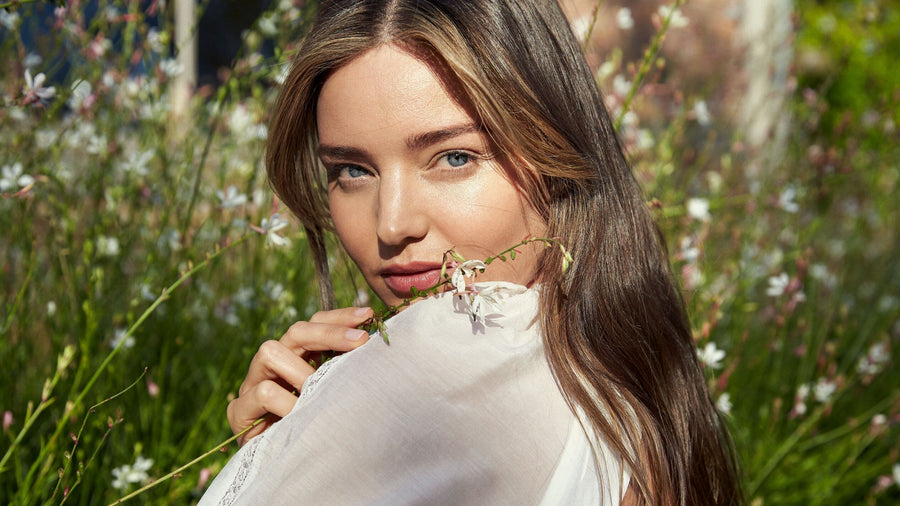
From Model to Mogul: Miranda Kerr on Nervous System Health and Building KORA Organics
As part of our International Women’s Month series, we’re sitting down with Miranda Kerr to explore what it truly means to live and lead well. Founder and CEO of KORA Organics, mother of four, and long-time advocate for certified organic beauty, Miranda’s approach to wellness has evolved from personal curiosity to integrated way of life. In this conversation, she opens up about nervous system regulation, conscious leadership, motherhood, and the daily rituals that keep her grounded in a world that constantly asks women to be “always on.”
We really admire your approach to living well. For those new to your world, can you tell us a little bit about what you do and how you spend your days?
I’m the founder and CEO of KORA Organics, a certified organic, results driven skincare brand and a proud mother of 4 boys.
My days are a blend of juggling leadership and motherhood. I usually begin with meditation and quiet time before the house wakes up. That grounding practice helps me lead with clarity and intention. From there it is school runs, meetings, reviewing product development, connecting with retail partners, and supporting our team across different markets.
Even in a leadership role, I try to build in small rituals throughout the day like a few conscious breaths, a walk outside, or applying my skincare with intention instead of rushing. For me, living well and leading well are connected. When I feel centered, I make better decisions.
In the late afternoon, I shift fully into family time, which includes dinner together, reading, and presence. That balance is deeply important to me. It reminds me that success is not just about growth or numbers, it is about how we live each day and how we show up for the people we love.
I also dedicate time to the charities close to my heart, including Baby2Baby and children’s hospitals. Giving back has always been important to me, especially when it comes to children’s health, women’s wellbeing and environmental causes.

How would you describe your relationship to wellness right now, and how has it changed over the years?
That’s such a great question because my relationship with wellness has really evolved as I’ve grown.
In my early twenties, wellness was very much about learning. I was curious. I was experimenting with nutrition, meditation, natural therapies, and trying to understand the connection between mind, body, and skin. It felt very personal and very discovery driven.
When I became a mother, wellness took on a deeper meaning. It was no longer just about how I felt, it was about the energy I was bringing into my home. I became even more aware of the importance of nervous system health, emotional balance, and creating daily rituals that grounded me. I realised that wellness is not something you achieve once, it is something you return to every day.
Now, my relationship with wellness feels more integrated and intuitive. It is less about adding more and more practices, and more about simplifying. This can look like protecting my peace, listening to my body, supporting my hormones, being mindful of my thoughts, and choosing nourishing food, movement, and skincare that align with my values.
Wellness isn’t just personal for me though. It’s also part of my responsibility in being a mother and in leadership. The way I care for myself directly influences how I show up for my children, my husband, and my team. It shapes the energy I bring into my home and into my work, impacting my clarity, my patience, my decision-making, and my creativity.
When I’m grounded and regulated, I’m able to lead from a much more intentional place. I truly believe you can’t lead others sustainably if you’re running on empty. For me, wellness is about creating that inner alignment so I can give from a place that feels full, steady, and authentic.
So today, I would say wellness feels less like something I “do” and more like how I live. It is woven into my mornings, my business decisions, my family life, and the way I speak to myself. It has become quieter, steadier, and more grounded over time.
You’ve built something incredible. Tell us about your business or platform and the one milestone that still gives you a major hit of dopamine when you think about it?
I created KORA Organics originally for myself and my family. When I was a teenager, my mother was diagnosed with tumours on her spleen, and it changed the way we looked at health and wellbeing. It made us realize how important it is to be mindful of what we put in and on our bodies, especially since our skin is our largest organ and what we put on our skin soaks in. When I couldn’t find skincare that met my standards, I decided to create it. I wanted certified organic, results driven skincare. That’s how KORA began.
Today, KORA Organics is a globally distributed brand certified under strict EcoCert COSMOS standards, and we remain deeply committed to ingredient integrity and performance. A milestone that still gives me a hit of dopamine is becoming the first certified organic skincare brand to launch at Sephora in the US. It felt like a breakthrough moment for certified organic beauty. But what truly stays with me are the messages from customers who feel more confident in their skin. That never gets old.

What’s one daily ritual you refuse to skip that genuinely supports your nervous system or keeps your energy levels in check?
My morning meditation. I feel everything flows much better in my day if I do my 20mins Vedic meditation. It’s the anchor for my nervous system. Before I check my phone, before the boys wake and the day begins, I sit, breathe and take this time for myself. That small pocket of stillness changes how I show up for the day, for my children, my team and my decisions. Meditation helps shift me into that parasympathetic state to be calmer, clearer and more grounded. It’s simple, but it’s powerful.
What's a wellness myth you’re ready to retire, or a “deep cut” practice you wish more people were talking about?
One wellness myth I’m very ready to retire is the idea that “natural” or certified organic skincare is less effective.
At KORA, our certified organic ingredients can contain up to 60% more antioxidants, which means more potency, purity and performance. You don’t have to compromise results to choose something that’s cleaner and more conscious. In fact, when ingredients are grown without toxic pesticides and are nutrient-dense, they can be even more powerful than conventional products. When we conducted independent consumer studies, 85% of retinol users said our certified organic moisturizer is more effective than retinol products used before.
A practice I wish more people were talking about is nervous system regulation. We focus so much on products and protocols, but if your nervous system is constantly in fight-or-flight, it impacts everything including your skin, digestion, hormones, and sleep.
Simple tools like breathwork, vagus nerve stimulation, heat therapy, even just stepping outside into nature, can signal safety to the body. And when the body feels safe, healing becomes much more accessible.
As a founder, you really know what it means to be “always-on” and that’s often a recipe for burnout. What’s your go-to protocol for a total mind-body reset?
When I feel depleted, I simplify. I’ve definitely had to learn this the hard way. Being “always-on” isn’t sustainable, and I’m very conscious now of building in reset moments before I hit burnout.
My go-to protocol is actually very simple — I strip everything back to the foundations. I prioritise sleep first. If my sleep is off, everything feels harder. Then I focus on nervous system regulation. Breathwork, meditation, gentle yoga or even just lying on the floor with my legs up the wall for ten minutes. Sometimes I’ll use tools like my Oura Ring to check in on recovery, or my HigherDOSE Sauna Blanket to support circulation and reset my energy.
And I unplug. Time in nature, no phone, being fully present with my boys. That’s the real reset. For me, a mind-body reset isn’t about adding more — it’s about returning to the basics and creating space for the body to recalibrate.

For women looking to drop out of their heads and back into their bodies, what advice would you offer?
Start small and sensory. I think as women, so many of us live in our heads because we’re constantly planning, solving, holding everything together.
The first step is to slow down enough to actually notice your body. Take your shoes off and stand on the earth. Feel the ground beneath you. Sit in a sauna and notice your heartbeat. Slow your breath until you can actually feel it move through your body. Use your skincare as a self-care ritual instead of a routine task. Massage it in slowly. Breathe in the aromatherapy. Let it be a moment of connection rather than something to tick off your list.
The body responds to presence. When you bring your awareness back to sensation – warmth, breath, touch – you naturally drop out of your head and back into yourself.
It doesn’t have to be complicated. It just has to be intentional.
I’m excited to see more conversation and a shift toward deeper understanding around hormones, gut health, nervous system regulation, perimenopause and longevity. Women want to understand their bodies, not override them.
We’re moving beyond trends and toward education, bio-individuality, and tools that support the body instead of overriding it. I love the bridge between ritual and gentle technology with things like infrared, red light, and recovery tracking that empower women to understand their own rhythms.
There’s also more conversation around bio-individuality. The idea that one size does not fit all. What works for your friend, or what’s trending online, may not be what your body needs.
Lastly, the shift from hustle and optimisation to greater alignment and regulation. Women aren’t just chasing productivity anymore – they’re prioritising balance, boundaries and longevity.